What Builds Us May Also Hold Us
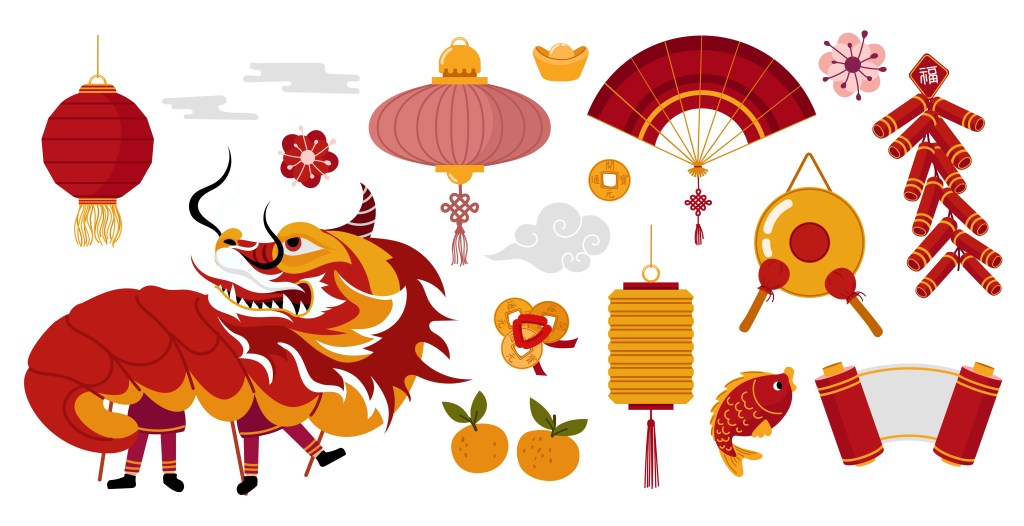
Growing up with Chinese New Year, the color red was never just a color, it was atmosphere, memory, and instruction.
It appeared on our doors, our clothes, our envelopes, our decorations. Long before we understood symbolism, we understood participation. Red meant celebration. Red meant protection. Red meant we were part of something larger than ourselves.
We did not pause to ask why.
We simply followed.
Only much later do many of us recognize something quietly remarkable: entire societies can organize themselves around stories.
One of the oldest is the legend of the Nian – a terrifying mythical creature said to emerge at the turn of the lunar year, feared for bringing destruction to villages. The solution, according to folklore, was simple yet coordinated: wear red, light firecrackers, make loud noises, and stay awake through the night.
Whether people today literally believe in such a creature is almost beside the point.
What matters is what the story accomplished.
It aligned behavior across families, communities, and generations. Strangers who would never meet still moved in cultural synchrony – decorating their homes, preparing reunion dinners, exchanging greetings shaped by centuries of repetition.
Long before modern institutions existed, shared imagination allowed humans to cooperate at scale. In a reflection on Unity Under Pressure, I explored how common threats, real or perceived, often become the invisible glue that brings people together. Chinese New Year traditions may be one of the oldest cultural expressions of this same human instinct.
Perhaps this is one of humanity’s quiet superpowers: our ability to act together not only because something is proven, but because something is collectively accepted.
Culture, in this sense, is more than tradition.
It is social coordination made visible.
Yet embedded within this strength is a paradox captured by the Chinese phrase:
成也文化,败也文化
What builds us can also bind us.
Culture gives us continuity. It offers belonging, identity, and a sense of orientation in the flow of time. Through rituals, we inherit emotional memory from people we may never have known.
But the very forces that stabilize a society can, if left unexamined, begin to constrain it.
Consider a familiar scene during the festive season: an elder gently, or sometimes firmly, disapproving of darker colored clothing, insisting that auspicious occasions call for brighter colors. Nearby, a younger family member chooses something understated, perhaps valuing personal expression over symbolic compliance.
At first glance, it may appear to be a disagreement about color.
More often, it is a quiet negotiation between preservation and autonomy.
Neither side is entirely mistaken.
One seeks continuity; the other, self-definition.
Across cultures, similar tensions unfold wherever tradition meets a changing world. Successful patterns endure precisely because they once served an important function. Over time, however, the original reasons may fade while the behaviors remain.
We inherit the practice, but not always the context.
There is a well-known metaphor often shared in discussions of social behavior: a group learns to avoid a certain action because of an initial deterrent. Eventually, even when the deterrent disappears, the avoidance persists.
Maintained not by understanding, but by imitation.
Whether literal or illustrative, the lesson feels familiar.
How often do we continue doing something simply because “this is how it has always been done”?
Status quo remains status quo for a reason, but not always for a relevant one.
And yet, recognizing this does not require us to reject tradition. Dismissing inherited practices too quickly risks losing the quiet wisdom they may still carry.
After all, not every ritual is irrational. Many encode psychological insight long before psychology had a name. Gathering for reunion dinners strengthens kinship bonds. Visiting relatives renews social ties. Offering well-wishes reminds us that hope is, at heart, a shared effort.
Perhaps the deeper invitation is not to abandon tradition, nor to obey it unthinkingly, but to understand it.
When we understand what invisible role a custom once played: protection, cohesion, reassurance, we gain the freedom to decide how it might continue, evolve, or soften with time.
Every culture walks this delicate line between honoring the past and making space for the present. What once safeguarded unity should not become a source of quiet division.
To reflect on culture, then, is not an act of criticism.
It is an act of care.
For what we examine thoughtfully, we preserve more wisely.
As the new year approaches and red once again fills our streets and homes, it may be worth pausing.
Not to question the celebration, but to see it more clearly.
Behind every ritual lies an old human hope: that by moving together, we may face the unknown with a little more courage.
Culture has carried us far.
Understanding it may carry us further.
For in the end, what builds a civilization deserves not only our participation, but also our reflection.
成也文化,败也文化.
 Futuring Note