Tag: life

  • The Duchess Within Us

    When pressure rises, do we silently rewrite the rules?

    It was meant to be comedy.
    A match where the rules kept changing mid-fight.
    Where confusion was part of the entertainment.
    Where structure existed mostly in name.

    Twenty-five years ago, the Duchess of Queensbury match between William Regal and Chris Jericho was simply hilarious. One of those wonderfully absurd moments in wrestling history.

    But watching it again today, something felt different.

    In that match, the stipulations kept escalating.

    What began as a structured contest slowly turned into controlled chaos. It begins with a standard rule, then comes increasingly bizarre conditions which heavily favor one side, until the disadvantaged competitor appeared unsure what would come next.

    At moments, it felt less like a sporting contest and more like a game where the finish line kept silently moving.

    And beneath the laughter, an uncomfortable question surfaced:

    How often do we have a Duchess of Queensbury within ourselves?’

    Adjusting the rules when the situation stops going our way?

    When the Game Stops Going Smoothly

    In the match, every time momentum began to build, the rules shifted.

    Victory conditions changed.
    Interruptions appeared.
    The path forward kept changing.

    At the time, it was brilliant comedy.

    But in real life, the pattern is far less amusing, and far more disturbingly common.

    When pressure rises, many of us do not always push harder.

    Sometimes, we quietly redefine the finish line.

    • The deadline becomes “flexible.”
    • The goal becomes “good enough.”
    • The commitment becomes “situational.”

    Not always out of dishonesty or laziness.
    Often, out of something much more human.

    Self-protection.

    The Quiet Comfort of Moving Goal Posts

    Very few people wake up intending to deceive others (including ourselves).

    But many of us, at some point, have softened a target when it began to feel out of reach.

    We tell ourselves:

    • “This was the real intention anyway.”
    • “Circumstances have changed.”
    • “This version still counts.”

    And sometimes, to be fair, adjustments are necessary. Life is dynamic. Rigidity can be foolish.

    But the danger lies in how effortlessly the human mind can blur the line between:

    • Thoughtful Adaptation, and
    • Quiet Avoidance.

    The Duchess of Queensbury match was funny precisely because the rule-changing was so blatant and executed humorously.

    In life, it is rarely announced.

    Where This Shows Up in Everyday Life

    We see this pattern more often than we might like to admit.

    In workplaces, when KPIs are quietly re-framed after results disappoint.

    In personal goals, when ambitious plans slowly shrink into safer versions.

    In parenting, when standards shift depending on how tired we feel that day.

    Even in our relationship with technology, when tools promise efficiency, and we gradually outsource more judgment than we originally intended.

    None of this makes us weak.

    It makes us human.

    But awareness matters.

    Because what begins as a small adjustment can, over time, reshape our standards without us fully noticing.

    The Discipline of Staying Honest With Ourselves

    The real lesson from that absurd match is not about wrestling.

    It is about self-observation.

    There are moments in life when adjusting the rules is wise.
    There are also moments when it is simply more comfortable.

    The difficult part is telling the difference, especially when we are both the player and the rule-maker in our own lives.

    Progress does not always require rigidity.

    But it does require honesty with oneself.

    Sometimes the question worth asking is:

    Am I adapting sensibly…
    or am I just making the game more tolerable?

    A Small Reflection

    The Duchess of Queensbury match was designed for laughter.

    But like many things that appear silly on the surface, it carries an oddly enduring mirror.

    Because long after the bell rings and the crowd fades, one quiet truth remains:

    The most dangerous rule changes are the ones we quietly approve ourselves.
  • Proudly Quiet

    On Being Introverted in a World That Often Rewards Noise

    Introverted… yes, I am.

    And for a long time, I wondered if that was something I needed to overcome.

    The world often celebrates those who think aloud, respond quickly, and command attention without hesitation. In many spaces, the fastest voice is mistaken for the clearest mind, and presence is easily equated with volume.

    For years, I quietly questioned myself.

    Should I speak more?
    Respond faster?
    Be more expressive?
    More visible?

    Time, and some growth, brought me to a quieter realization:

    Introversion was never a flaw.

    It was simply my design.

    I am a proud ISTJ.

    Not because labels define me, but because understanding how I am wired has allowed me to stop resisting my nature and start working with it.

    Quiet Does Not Mean Empty

    There is a common misunderstanding that quiet people have less to offer.

    In truth, many introverts are not short of thoughts, we are often holding several at once. While conversations move forward, our minds are observing patterns, weighing possibilities, and connecting details others may overlook.

    We may not enter a discussion immediately.
    But when we do, it is rarely without consideration.

    Over time, I have learned that depth does not need to announce itself. It reveals itself in the quality of what is built, the steadiness of decisions, and the consistency of follow-through.

    Not everything meaningful needs to arrive loudly.

    The Strength of Preparation

    I do not enter every room with a strong presence.
    But I enter prepared.

    Where some rely on spontaneity, I have learned to rely on thoughtfulness. Preparation has become a quiet form of confidence.

    One that does not demand attention, yet rarely abandons me when it matters most.

    The world may notice charisma first.
    But it runs, more often than we realize, on reliability.

    And reliability is rarely loud.

    The Turning Point: No Longer Apologizing

    Perhaps the greatest shift did not happen when I understood introversion.

    It happened when I stopped apologizing for it.

    For a while, I stretched myself into shapes that were admired but unnatural – speaking when reflection would have served better, participating for visibility rather than contribution.

    Growth asks us to expand.
    But it should never require us to abandon our design.

    There is a quiet freedom that comes when you stop measuring your worth against someone else’s temperament.

    You stop performing.
    You start aligning.
    And things started, and naturally, falls in place.

    I no longer see quietness as something to overcome.
    It is the ground from which I stand.

    Energy Is Meant to Be Managed

    Introversion has taught me something invaluable: energy is finite.

    Not every invitation needs acceptance.
    Not every silence needs filling.
    Not every opinion requires immediate expression.

    There is strength in discernment, in knowing where your presence is most meaningful and where your energy is best conserved.

    When we stop scattering ourselves across every demand, we gain the ability to show up fully where it truly counts.

    Introversion is not withdrawal.

    It is intentional engagement.

    Quiet Builders

    The world will always have space for those who shine brightly and speak boldly.

    But it is also sustained by quieter builders – people who think carefully, act deliberately, and continue to burn steadily long after excitement fades.

    Much of what holds our lives together is created not through noise, but through patience.

    Not through display, but through quiet conviction.

    Great work does not always announce itself. Often, it deepens slowly, almost invisibly, before anyone thinks to call it great.

    Becoming More Yourself

    Today, I no longer wish to be louder than I am.

    Only steadier.
    Only clearer.
    Only more myself.

    Understanding who you are is not about placing limits on your growth. It is about removing the unnecessary friction of trying to become someone you were never meant to be.

    And there is a quiet strength in that.

    Not everything meant to last needs to begin loudly.

  • What We Build, We Learn to Value

    On Turning the IKEA Effect into a Quiet Advantage

    We often hear about cognitive biases as flaws in human thinking. Tendencies that distort judgment and quietly shape how we assign value.

    Behavioral researchers once observed a curious tendency:
    We often value things more when we help build them.
    This became known as the IKEA Effect.

    At first glance, it appears irrational. Why should a slightly crooked table feel more precious than a perfectly crafted one?
    Simply because we built it ourselves?

    Yet, perhaps this bias is not a weakness to eliminate, but a force to understand, and even to use wisely.

    The Bias Is Not the Problem – Unconscious Living Is

    The danger of the IKEA Effect is not that we value our own work.

    The danger lies in valuing without awareness.

    Left unseen, it can quietly anchor us to things that no longer serve us:

    • Staying too long in projects we should release
    • Defending ideas simply because they are ours
    • Holding onto systems that have outlived their usefulness

    But when recognized, the same psychology becomes something else entirely:

    A quiet generator of meaning.

    Effort changes how the mind assigns value.

    We do not merely appreciate the object, we remember the hours, the decisions, the small acts of persistence embedded within it.

    Value is no longer found only in the outcome.

    It begins to live within the participation itself.

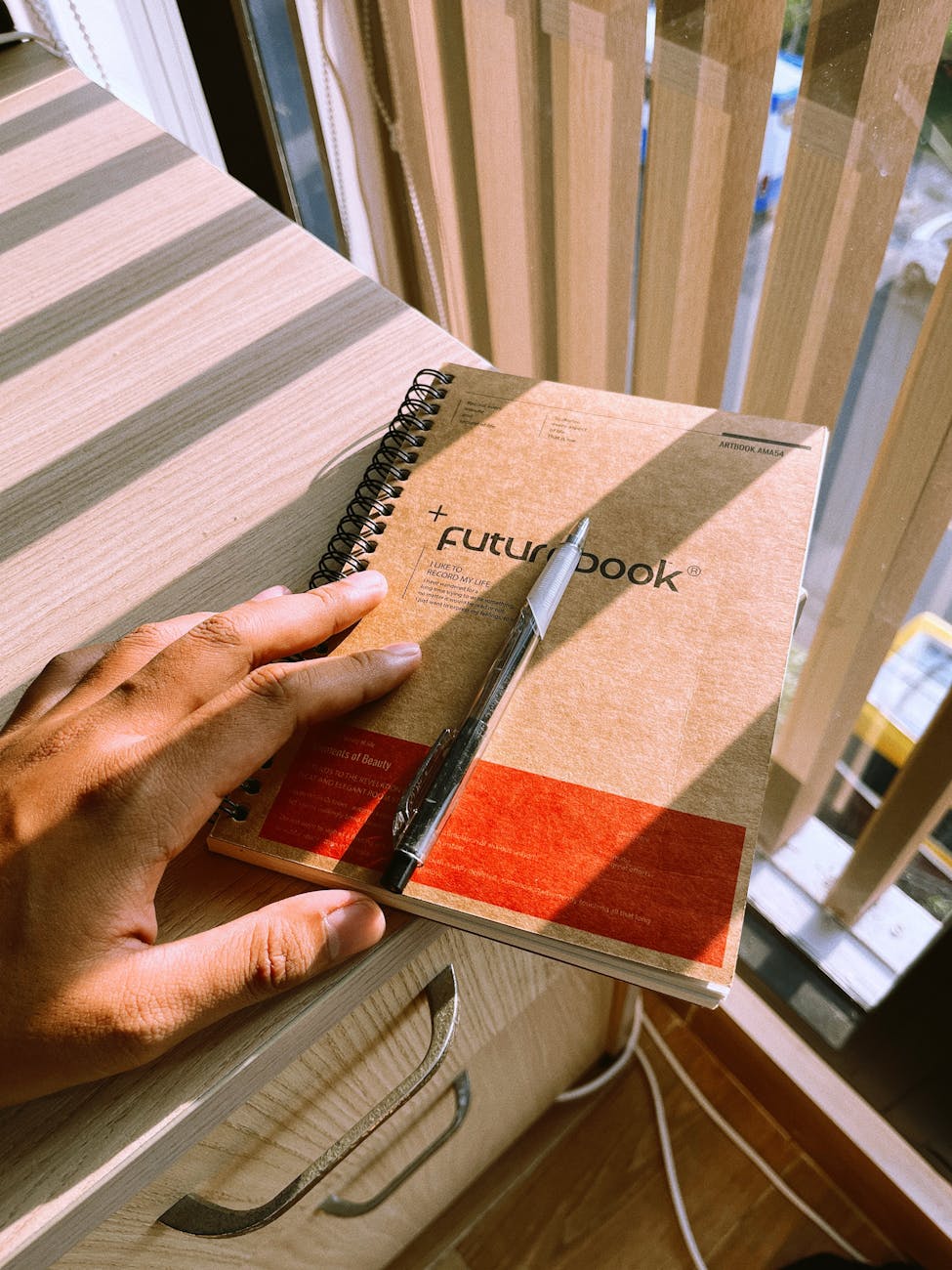
    Why a Refillable Notebook Feels Different

    A disposable notebook is complete the moment it is purchased.

    A refillable notebook is not.

    It asks something of you.

    To choose the paper.
    To rearrange the sections.
    To decide what deserves to be kept, and what can gently be released.

    Over time, the notebook stops being a product.

    It becomes evidence of authorship.

    Not perfection.

    Authorship.

    And authorship invites care.

    This is the IKEA Effect at its quiet best:

    What we help shape, we are less willing to abandon.

    Not because it is expensive, but because it carries traces of our attention.

    Life Is Less Like Buying Furniture and More Like Assembling It

    Modern life tempts us with ready-made paths.

    Optimized routines.
    Predefined success markers.
    Templates for how a life should look.

    Yet the lives that feel most meaningful are rarely pre-assembled.

    They are:

    Adjusted.

    Rebuilt.

    Questioned.

    Refined.

    Sometimes slowly.
    Sometimes messily.
    But always personally.

    The IKEA Effect reminds us of something worth remembering:

    Meaning tends to grow wherever effort has been invested.

    Not all effort is wise, of course. Discernment still matters.

    But a life assembled with care, rather than inherited by default, begins to feel unmistakably like one’s own.

    Turning the Bias Into an Advantage

    Instead of resisting this tendency, we might gently ask:

    Where is effort worth investing?

    A few quiet places come to mind:

    • Designing your own systems rather than copying blindly
    • Writing thoughts instead of only consuming information
    • Building rituals that reflect personal values
    • Revisiting and refining – rather than constantly replacing

    When participation increases, attachment often deepens.

    And sometimes, attachment is precisely what sustains consistency.

    A Gentle Caution

    There is wisdom in remembering that not everything we build is meant to be kept. Growth occasionally requires disassembly.

    Yet the same effort that teaches us to value what we create can also make it harder to release what no longer serves us. Psychologists describe this as the sunk cost fallacy – our quiet reluctance to let go after investing time, energy, or care.

    What begins as meaningful participation can slowly turn into unnecessary attachment. The goal, then, is not stubborn holding, but conscious authorship.

    To care for what remains life-giving, and to release with clarity when the time comes.

    Closing Reflection

    Perhaps the IKEA Effect is not a psychological flaw after all.

    Perhaps it is a quiet invitation:

    To move from consumer to participant.
    From receiver to creator.

    Because what we help build, we are far more likely to value.

    And what we value we are far more likely to tend to.

    In the end, perhaps the goal is not to build perfectly, but to build consciously, so that what we shape, quietly shapes us in return.

  • Busy? Or Just Believing You Are?

    We often assume that our judgments are rational.

    That we see people, situations, and even ourselves as they truly are.

    But human perception is rarely that neutral.
    More often than we realize, a single dominant signal quietly shapes the way we interpret everything else.

    Psychologists sometimes describe this as a cognitive shortcut: when one strong impression forms, the mind begins to color the whole picture around it.

    Success can make someone appear more credible than they truly are. A single mistake can cause everything else to be viewed through a harsher lens.

    Perception, once formed, is remarkably persuasive and this pattern does not only apply to how we see others.

    It also shapes how we see our time.

    When One Signal Becomes the Whole Story

    Consider what happens when you glance at a heavily-packed schedule.

    Meetings stacked back-to-back.
    Tasks spilling into the evening.
    Reminders nudging for attention.

    Within seconds, a conclusion arises:

    “I have no time.”

    But pause for a moment.

    Is it always true?
    Or has the appearance of fullness become the story we tell ourselves?

    The mind prefers quick interpretations.
    A crowded schedule becomes a powerful visual cue, and from that single cue, a broader identity quietly emerges:

    I am busy.
    I am stretched.
    My days are spoken for.

    Over time, this stops being an observation.

    It becomes a belief.

    The Hidden Cost of That Belief

    Busyness itself is not the problem.

    A fully-packed life can be a meaningful life.

    The hidden cost surfaces when busyness hardens into self-definition, when we stop examining whether every commitment still deserves its place.

    Because once the mind accepts “I have no time,” something subtle begins to happen:

    We decline opportunities without fully exploring them.
    We protect routines that may no longer serve us.
    We assume that time spaciousness belongs only to some distant future.

    Doors close quietly

    Often before we even reach for the handle.

    Not because time is absent,but because possibility no longer feels available.

    The Psychology of White Space

    Interestingly, many intentional individuals do not strive to fill every hour.

    They protect white space.

    Not as laziness.
    Not as inefficiency.

    But as psychological breathing room.

    White space signals freedom to the brain.
    It restores our sense of choice.

    Without it, even small requests can feel intrusive.
    With it, we respond with greater clarity and intention.

    What changes is not the number of hours, but our relationship with them.

    Busyness as an Identity

    There is another layer worth noticing.

    Sometimes, without meaning to, we become attached to the idea of being busy.

    “Things are crazy lately.”
    “I barely have a moment.”
    “It’s been non-stop.”

    At first, these phrases describe reality.

    But repeated often enough, they begin to shape it.

    Busyness gains a quiet prestige in modern life.
    It can signal importance, relevance and momentum.

    Yet a life constantly announced as overwhelming rarely leaves room for reflection where a reflective mind is where direction is refined.

    The question, then, is not whether we are busy as most adults are.

    The gentler question is:
    Has busyness become a belief? One we no longer question?

    Seeing More Clearly

    Awareness alone can soften this pattern.

    The next time your schedule looks impossibly full, pause before accepting the conclusion it presents.

    Ask instead:

    • Is every commitment equally necessary?
    • What would happen if one ‘task’ were to be removed?
    • Where is my white space?
    • Am I guarding my time, or merely reacting to it?

    Often, clarity does not require a dramatic life change.

    Only a willingness to see beyond the first impression.

    Because a calendar, like any representation, tells a story.

    And stories can be revised.

    In an earlier reflection, I wrote about keeping time for yourself, not as a luxury, but as a quiet necessity.
    Perhaps seeing our time clearly is where that keeping begins.

    A Quiet Reminder

    Perhaps the goal is not to eliminate busyness altogether.

    But to remain its author, rather than its subject.

    To remember that time is not only something we spend,
    but something we shape and utilize.

    And sometimes, the most important freedom is simply this:

    To recognize that the feeling of having no time
    may begin not in the clock…but in the mind.

    Perhaps we do not always need more time.
    Sometimes, we simply need to see it more clearly.

  • Time – Kept for yourself

    Time is the most equitably distributed asset that every individual possesses, unaffected by societal status or wealth. Each of us has the same 24 hours in a day. No more, no less. Yet, it’s common to find ourselves pondering, “After being busy all day, what have I actually achieved?” or wishing for “just one more hour in the day,” and questioning, “Where has my time gone?”

    This reflection was inspired by the Chinese song “Where Has the Time Gone?” (时间都去那儿了?Shí jiān dōu qù nǎ le) performed by Reno Wang. It stirred within me the desire to share these thoughts and the often untapped potential of your diary.

    While keeping the original meaning intact, I’ve made slight adjustments to improve readability in English.

    Here is an extract of the song:
    Where has the time gone?
    Before we could fully experience youth, we've aged
    Raising sons and daughters for a lifetime
    Has filled my mind with the cries and laughter of children

    As the father of a 3-year-old boy, I have often heard people from all walks of life remark, “Kids grow up so quickly,” and suddenly, they’re adults before you realize it. This sentiment didn’t fully resonate with me until my son turned three in what felt like the blink of an eye. When you think about it, if children grow up ‘fast’, it implies that our parents age ‘fast’ as well.

    So do we.

    Yet, ‘fast’ is subjective. Given that ‘time’ ticks at a uniform rate for everyone, how does the concept of ‘fast’ emerge? The explanations include investing excessive time and energy in others, neglecting personal ‘me-time’ to genuinely savor moments alone, and engaging in unnecessary activities or simply squandering time.

    This realization led me to reflect on how I’ve been spending my time, and how I might want to spend it more intentionally in the future.

    Actionable advice:

    1. Review

    Flip through your monthly, weekly, or daily pages and observe your usual days. Are they filled with meaningful tasks, unavoidable responsibilities, or activities that keep you busy but leave you feeling empty?

    Do these activities drain your energy or nourish your spirit?

    2. Remove

    Highlight the activities that are “not good” for you, and list them on a note page. This becomes your personal “avoid” page — a reminder of what to say no to in the future.

    3. Revitalize

    Next, use a year planner (usually one page for the whole year with small daily grids) and mark the days, dates, and occasions that truly matter to you and are fixed. For example, birthdays and anniversaries.

    These are not just reminders; they are non-negotiable time you’ve intentionally kept for yourself and your loved ones. So the next time an invitation comes in, instead of accepting it spontaneously over the phone or through a quick message, take a step back and flip through your planner. Ask yourself: Is this a time I’ve already reserved for myself, or is it truly a free slot? This small pause helps you make decisions more consciously, and protects the moments that matter most to you.

    The key word here is: truly matters.
    Remember, this is your time, kept for yourself.

    Tip:
    We recommend using a refillable diary planner, so you can move your “avoid” page to any section of your book, keeping that reminder close, whenever you need it.

    Summary
    In the end, a diary is not just a place to record what you have done, it is a space to remember what truly matters to you. When you review, remove, and revitalize how you spend your days, you begin to live more intentionally, not just busily. So before time slips quietly past again, pause, reflect, and choose what deserves a place in your life.

    Make time for yourself, because your time is your life.

    If any part of this reflection resonates with you, or if you have any questions, please feel free to reach out, I’d be more than happy to connect.